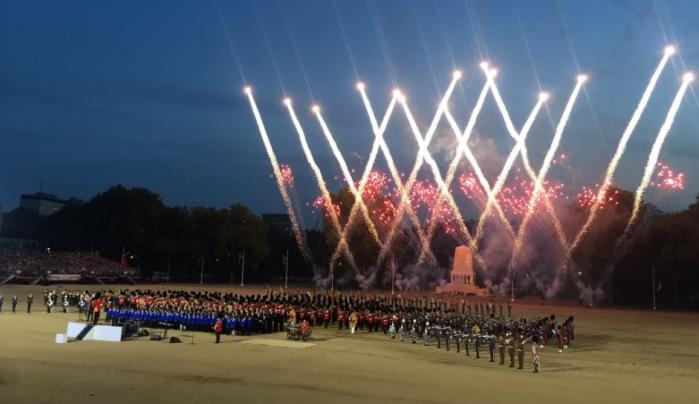
On three successive evenings each year a magnificent pageant of military music, precision drill and colour takes place on Horse Guards Parade in the heart of London when the Massed Bands of the Household Division carry out the Ceremony of Beating Retreat. It is an unforgettable evening as 300 musicians, drummers and pipers perform this age-old ceremony. The Retreat has origins in the early days of chivalry when beating or sounding retreat pulled a halt to the days fighting, a return to camp and the mounting of the guard for the night. Today, Beating Retreat, has become a major event in the Army’s ceremonial calendar, delivering an evening of spirited marches as well as poignant and evocative hymns and anthems of special significances to our fighting forces everywhere. The salute is usually taken by a member of The Royal Family. The participants of Household Division Beating Retreat are drawn from the band of the two Household Cavalry Regiments and the five Foot Guards Regiments which make up the Household Division. London District Retreats and Tattoos have been held at Horse Guards Parade since the early post-war years as the Government hoped that the sight of the Guards back in full dress would help to inspire the Nation after years of austerity. These were held on Saturday evenings and included the Massed Bands, Drums and Pipes of the Brigade of Guards as well as the Musical Drive of the King's Troop Royal Horse Artillery and the Musical Ride of the Household Cavalry. Beating Retreat by the Household Division in its current form has taken place annually since 1966 (other than in 1970) and raises money for service charities. From 1977 until 1998 it was held later in the evening and illuminated by soldiers of the Territorial Army using search lights retained from the Second World War. For some years it returned to late afternoon but, with the introduction of floodlighting in 2009, it was again put back to sunset as the lights fuly enhance the beautiful setting of Horse Guards Parade with St. James's Park. As an annual event, Beating Retreat is a challenge to each Senior Director of Music who must keep innovating whilst retaining the traditional military standards that exemplify the Household Division. Also, the Massed Bands of The Royal Marines have been Beating Retreat on Horse Guards Parade approximately every other year since 1960. |
The Massed Bands of HM Royal Marines Beating Retreat
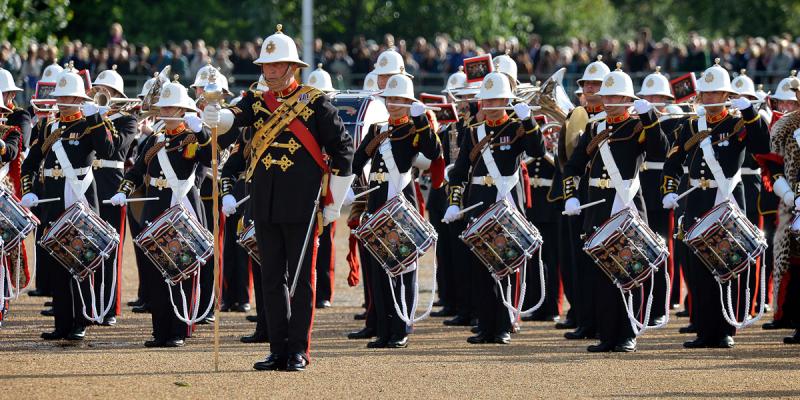
The
Massed Bands of HM Royal Marines Beat Retreat on Horse Guards
Parade every two years.
The next parade will be in July 2026.
Origins of Beating Retreat The origin of 'Beating Retreat' lies with the original purpose of military music. Today's battlefield commanders pass orders to their troops using state of the art communication systems; their forebears merely instructed their Drummer or Trumpeter to beat or sound a particular call. Similarly, before clocks were common and the wristwatch had been invented, drum beating or trumpet calls regulated a soldier's life in barracks. "Retreat" started with a signal given by the beat of a drum to order troops to break off fighting as darkness fell. Later, when in camp, it became used to warn outlying troops to withdraw to the confines of the encampment before picquets were set for the night. One of the earliest references can be found in the 'Rules and Ordyances for the Warre' of 1554 where it was called 'Watch Setting'. In 1727 Humphrey Bland's 'Treatise of Military Discipline' stated: "Half an hour before the gates are to be shut, generally at the setting of the sun, the Drummers of the Port Guards are to go upon the ramparts and beat a Retreat to give notice that the gates are to be shut". Over time "Retreat" has come to signal the end of the working day and the lowering of the unit flag and the accompanying call is still sounded daily in many units when operational circumstances permit. On special occasions the Corps of Drums play Retreat Marches, written in a 3/4 time signature and often adapted from folk tunes, which continue the tradition of the old Drum and Flute Duty. Nowadays we build concerts around the traditions of both beating "Retreat" and beating "Tattoo". The distinction between them was set by The Duke of Cumberland when he ordered: "The Retreat is to beat at Sunset and the Tattoo is to be beat at a later hour as ordered by the Commandants of individual encampments". Now a military "Tattoo" tends to be a more complex display that might feature bands from a number of units, as well as military displays of drill, riding, vehicles and the re-enactment of battle scenes, all culminating with the sounding of Tattoo (or the Last Post). "Beating Retreat" is usually a purely musical display, mostly in the early evening, ending with the sounding of Retreat (the call known as "Sunset" in the Royal Navy). |
Website design and management by: TurnipNet
e-mail : retreat@trooping-the-colour.co.uk
Please note: This
is not an official website. Please check official sources for up
to date information about military events.
The HQ London District official webpage is at: www.householddivision.org.uk

Return to home page